
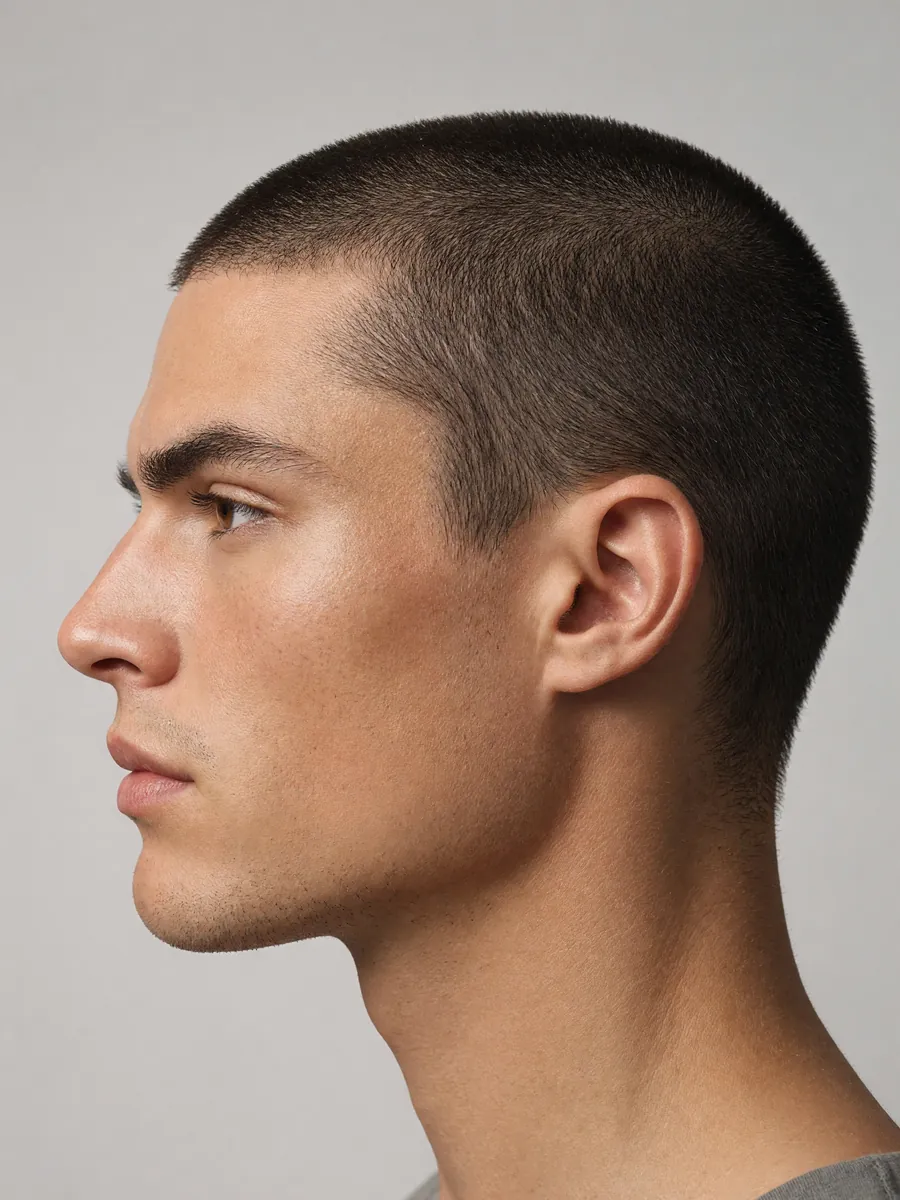
The hairline library
Twelve hairline designs, when each one is used, and the rules that keep a hairline natural.
Last reviewed Nov 16, 2026 · General information, not medical advice.
| Style | What it looks like | Often used for | Watch for |
|---|---|---|---|
| Soft natural | Fine, scattered dots at the front building into full density | The safest default; mature clients; first-timers | Can look unfinished on very dark hair if too soft |
| Broken | Irregular, slightly jagged edge with more presence | Recreating an original hairline | Irregular must look random, not zig-zag |
| Sharp edge-up | A crisp barbershop line-up | Clients who keep a groomed shape-up | Hardest to change later; can look drawn on if too low |
| Straight squared | Flat front, squared corners | Younger clients with a naturally straight line | A low, perfectly straight line is the main "helmet" risk |
| Rounded | Gentle curve, soft temples | Softer looks; the basis of most women's lines | On men, keep a little temple recession |
| Widow's peak | A soft V at the center | Clients who have or had one | Preserve or soften; do not invent one |
| Mature receding | Higher, with natural temple recession | Most adults over 30; ages well | Corners should still be framed |
| Strong temples | Corners and temple points rebuilt fully | Younger clients who never receded | Over-filled temples look juvenile |
| Soft temples | Corners rebuilt partly, softened | A frame without a youthful look | Temples are naturally lower density |
| Receded temples | Adult recession left at the corners | Mature, understated looks | Keep a light anchor so the front does not float |
| M-shaped | Center held, both temples set back | A common, stable adult line | A deep M reads as active loss |
| Juvenile low | Low and straight, close to the brows | Rarely recommended | Looks unnatural with age; cannot be raised without removal |
Design rules
- Age-appropriateHigher and softer as age rises. You can lower a hairline later, but raising it needs removal.
- Soft cornersThe front corner sits above the outer corner of the eye at a soft angle, never a sharp 90°, and never lower than the center.
- Transition zoneThe front edge uses the finest, most random dots and builds density gradually. No solid bar.
- Symmetry, not perfectionBoth sides are measured, but small natural differences stay. Perfect symmetry looks fake.
- Old photosPhotos from your twenties show where your line and temples sat.
- Map and approveThe outline is drawn and approved in the mirror before any pigment.
- Plan aheadThe design should still make sense if hair loss continues.
Keep reading
Brows
Brow techniques, decoded
Hand strokes, machine strokes, powder and combination: what each one is, and who it tends to suit.
ColorColor theory for skin
Undertones, pigment choice, and why healed color can shift over the years.
HealingHealing, day by day
What to expect from the first day to the settled look, and the aftercare most artists give.